
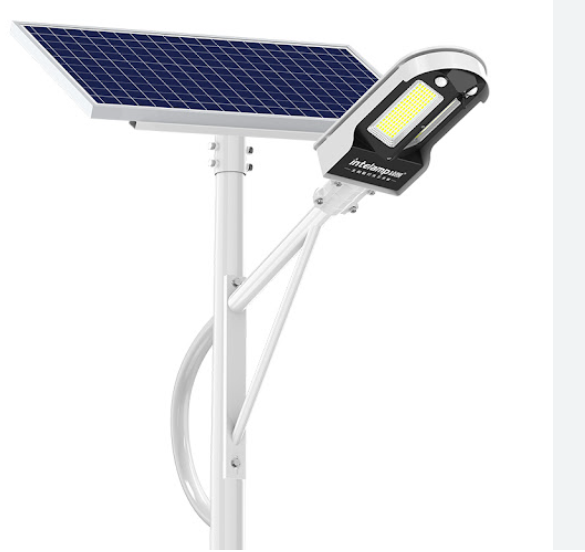
With the increasing popularity of green energy concepts, solar streetlights, with their advantages of energy saving, environmental protection, and low operation and maintenance costs, have been widely used in various scenarios such as urban auxiliary roads, rural roads, and scenic trails. Illumination range, as a core indicator for measuring the practical value of solar streetlights, directly relates to road safety and nighttime environmental comfort. This article will delve into the key factors affecting the illumination range of solar streetlights, explore optimization strategies, and provide a reference for the selection and layout of related application scenarios.Solar-Powered LED Lights Automatically Illuminate the Night
Light source performance is the fundamental core factor determining the illumination range. Currently, the mainstream solar streetlight uses LED light sources, whose power, luminous efficacy, and beam angle directly affect the illumination coverage area. Generally speaking, the higher the power of the LED light source, the higher the luminous flux and the wider the illumination range. For example, the effective illumination radius of a 30W LED solar streetlight is typically 8-12 meters, while a 50W power LED can increase it to 12-15 meters. Meanwhile, the choice of beam angle must be adapted to the scene requirements. Wide beam angles (above 120°) are suitable for open rural roads, enabling large-area illumination; narrow beam angles (60°-90°) are suitable for urban sidewalks, concentrating light to improve local brightness. Furthermore, the color rendering index and decay rate of the light source indirectly affect the actual effect of the lighting range. High-quality LED light sources can ensure the stability of the lighting range during long-term use.The Sensor-Based Function of Solar Garden Light Strips
Installation parameters also significantly affect the lighting range of solar streetlights. Installation height is one of the key factors. Generally, for every 1 meter increase in height, the lighting radius can increase by 0.5-1 meter. However, excessively high installations will lead to a decrease in ground illuminance, requiring precise balance. Taking a typical rural road as an example, an installation height of 6-8 meters paired with a 30-40W LED light source can achieve effective lighting coverage of 15-20 meters. The installation angle also needs to be reasonably adjusted. The tilt angle of the lamp is generally set at 5°-15° to allow the light to better cover the road surface and avoid lighting dead spots. Furthermore, the spacing between streetlights needs to be scientifically planned according to the lighting range, typically 3-4 times the installation height, to ensure effective connection of the lighting range of adjacent streetlights without obvious dark areas.Shining for a Decade: How Solar LED Lights Use Technology to Redefine Longevity
Environmental factors and system configuration also indirectly affect the lighting range. Rainy weather reduces the charging efficiency of solar panels. If the system’s energy storage is insufficient, streetlights may automatically reduce their power, resulting in a smaller lighting range. Therefore, it is necessary to configure batteries with sufficient capacity and high-efficiency solar panels according to local climate conditions. At the same time, road obstructions (such as trees and buildings) will block light transmission, reducing the actual lighting range. Installation should avoid obstructed areas or mitigate the impact by adjusting the height and angle.
For purchases, please add the following WhatsApp contact.
Optimizing the lighting range of solar streetlights requires comprehensive design based on scenario requirements: 40-50W LED light sources can be used for rural main roads, with an installation height of 8-10 meters, achieving 20-25 meters of lighting coverage; 20-30W light sources and an installation height of 6-7 meters should be used for urban sidewalks, ensuring uniform illuminance within a 12-15 meter range. Furthermore, solar streetlights equipped with intelligent control systems can automatically adjust their power based on ambient brightness and traffic demand, maximizing energy efficiency while ensuring effective lighting.
In summary, the illumination range of solar streetlights is influenced by multiple factors, including light source performance, installation parameters, and environmental conditions. Scientific selection, precise installation, and reasonable configuration can fully leverage the lighting advantages of solar streetlights, providing safe and efficient nighttime lighting for various road scenarios and contributing to the high-quality development of green transportation infrastructure.