
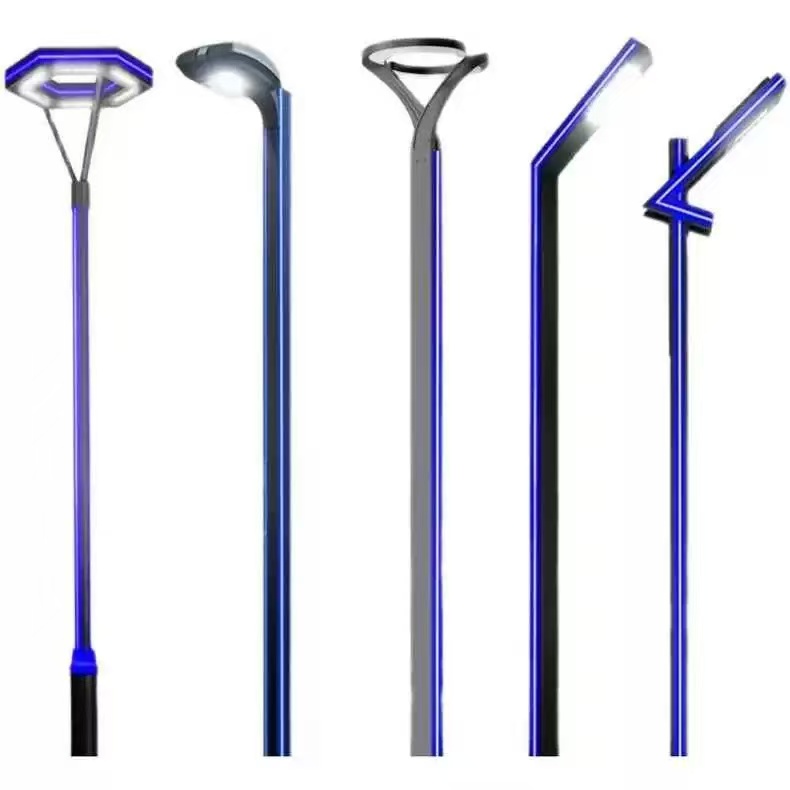
Many people have had the experience of encountering a “lazy” solar streetlight that only illuminates a few steps before becoming completely dark, making walking unsettling. Actually, the distance a solar streetlight shines isn’t a matter of luck, but rather determined by several key factors. Today, we’ll discuss this in simple terms.
First, let’s talk about the bulb’s wattage, which is crucial in determining the lighting distance. Just like a table lamp, a higher wattage bulb shines farther, while a lower wattage bulb only illuminates a small area of the table. The same applies to solar streetlights; common wattages range from 30 watts to 150 watts. A 30-watt bulb can illuminate about 15 to 20 meters, suitable for narrow paths in residential areas; for main roads at village entrances, you’ll need 100 watts or more, which can easily illuminate 30 to 50 meters, making walking at night as bright as day.A Complete Guide to Ground Installation of Solar Garden Lights
Next is the installation height, a point many people easily overlook. Think about it: if streetlights are installed too low, the light is concentrated in a small area at your feet, naturally limiting its range; if they’re installed too high, the light spreads out, making the ground area less bright. Generally, an installation height of 3 to 6 meters is ideal. A 3-meter height with a 30-watt bulb is just enough to illuminate a neighborhood walkway; a 6-meter height with a 100-watt bulb can fully cover a main road at the village entrance. If installed higher than 6 meters, you’ll need to use a higher-wattage bulb, otherwise it’s like “using a cannon to kill a mosquito”—a waste of electricity and ineffective.Can Solar LED Lights Be Installed on Billboards?
The battery capacity is also crucial, as it determines whether the streetlight can “stay lit” for the entire day. Solar streetlights rely on sunlight to store electricity. If the battery capacity is small, it won’t store enough power, and the light will dim quickly at night, naturally shortening the illumination distance. It’s like a mobile phone automatically dimming when the battery is low. Therefore, when choosing solar streetlights, you need to consider not only the illumination distance but also the battery capacity, especially in winter when daylight is short. Insufficient battery capacity might mean the light is on around 5 or 6 pm but dimmed again around 8 or 9 pm.Can Solar LED Lights Be Installed in Carports?
Weather does affect the lighting distance, which is unavoidable. During prolonged periods of cloudy or rainy weather, solar panels don’t receive enough sunlight, resulting in less stored electricity. The streetlights automatically reduce their power consumption to conserve energy, lowering the brightness and thus illuminating a shorter distance. However, modern solar streetlights are optimized for design and can generally withstand 3 to 5 days of cloudy or rainy weather. Unless there’s a week-long downpour, they can generally guarantee normal lighting. In exceptionally bad weather, you’ll just have to make do and be careful where you step.
Furthermore, the angle of the light is crucial. Some streetlights emit diffused light, while others focus it. Focused light illuminates further but over a narrower area; diffused light illuminates closer but over a wider area. For example, diffused light is suitable for park paths, illuminating roadside plants and steps; focused light is better for highways, illuminating the end of the road and helping drivers see clearly.
When choosing solar streetlights, don’t be confused by the technical jargon used by vendors. Remember a few simple ways to judge: check the power, ask about the height, and check the battery capacity, then choose according to your needs—choose 30 to 50 watts and 3 to 4 meters high for small roads in the neighborhood; choose 100 watts or more and 5 to 6 meters high for main roads at the village entrance. Solar streetlights selected in this way can illuminate far and stay lit for a long time, so you no longer have to fumble in the dark when you go out at night.