
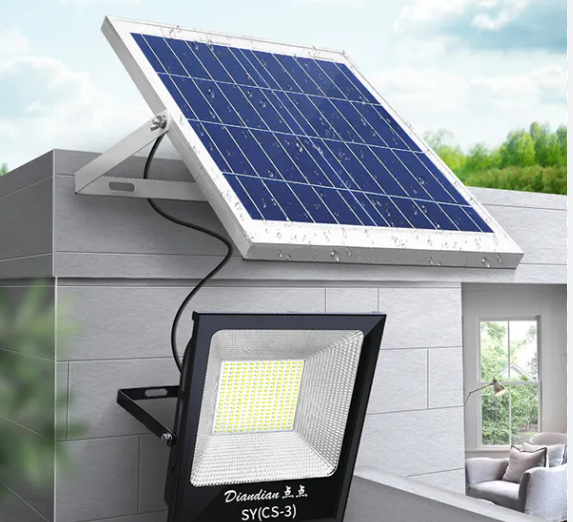
Are Solar LED Lights Really Energy-Saving? A Surprising Economic Analysis
As night falls, solar LED lights that automatically illuminate courtyards, balconies, or paths not only adorn the night but also represent a modern, low-carbon lifestyle. However, a practical question arises: are these seemingly “free” lights actually energy-efficient? The answer is clear and dual: they are not only extremely energy-efficient but also fundamentally redefine the concept of “electricity consumption.”Can Solar LED Lights Work in the Rain?
I. Dual Energy Saving: From “High Efficiency” to “Zero Consumption”
The secret to the energy-saving performance of solar LED lights lies in the combined effect of two core components, achieving energy conservation from source to end.
- LED Light Source: A Revolution in Electro-Optical Conversion Efficiency
LEDs (Light Emitting Diodes) are themselves a benchmark for energy-saving technology. Compared to traditional lighting, their advantages are astonishing:
· Compared to incandescent bulbs: LEDs consume only 1/10 of the energy while providing the same or even better brightness. A 5W LED light has the brightness equivalent to a 40W or higher incandescent bulb.Are Ground-Plug Solar Garden Lights Easy to Use?
- Compared to energy-saving lamps: LEDs consume about half the energy of energy-saving lamps and are mercury-free, making them more environmentally friendly.
- Long lifespan: High-quality LEDs have a lifespan of 25,000 to 50,000 hours, more than 25 times that of incandescent bulbs, significantly reducing indirect costs and resource consumption associated with replacing light fixtures.
Therefore, from the perspective of “power consumption for light emission” alone, using LEDs is already the most efficient and energy-saving choice.
For purchases, please add the following WhatsApp contact.
- Solar Power: Energy Self-Sufficiency
This is where the revolutionary nature of solar-powered LED lights lies. Through photovoltaic panels, it directly converts and stores sunlight (an inexhaustible renewable energy source) during the day. This means:
- Zero grid consumption: Under normal operating conditions, it consumes absolutely no electricity from the household or municipal grid.
- Zero electricity bill increase: No matter how long it’s on, your electricity bill will not increase by a single penny. Its “electricity cost” is prepaid by the sunlight.Is White Light or Warm White Light Better for Solar LED Lights?
II. A Simple Economic Calculation
Let’s assume you install 10 decorative solar LED lights in your yard, each with a power consumption of approximately 0.5W (the low power consumption advantage of LEDs is evident here), automatically lighting for 6 hours each night.
· If using mains electricity (even with the same LED lights):
Annual electricity consumption ≈ 10 lights × 0.5W/light × 6 hours/day × 365 days ÷ 1000 = approximately 10.95 kWh.
At a residential electricity price of 0.6 yuan/kWh, the annual electricity cost would be approximately 6.57 yuan. While the amount is small, it accumulates over time, and the initial cost is high due to the need for wiring and installation.
· If using solar LED lights:
Annual electricity cost = 0 yuan.
The entire “energy cost” lies in the one-time purchase price of the product. Typically, a qualified solar light, during its long lifespan (usually 3-5 years or more), will incur almost no further energy costs besides possibly replacing the rechargeable battery once.
The conclusion is obvious: from a long-term perspective, the energy cost savings of solar LED lights are absolute, especially for outdoor lighting requiring multiple locations and long distances (such as garden paths and fence decorations), where the advantages of eliminating cable laying and accumulated electricity bills are amplified.
III. Environmental Protection and Energy Saving: A Deeper Contribution
Saving electricity is not just about saving money, but also about environmental responsibility. Solar LED lights also offer significant environmental benefits:
· Reduced Carbon Emissions: Saving one kilowatt-hour of coal-fired power from fossil fuels is equivalent to reducing approximately 0.8 kilograms of carbon dioxide emissions.
· Zero-Pollution Operation: The power generation process is noiseless, exhaust-free, and radiation-free.
· Promotes Renewable Energy Utilization: Individual use of solar energy directly reduces the pressure on the power grid and dependence on non-renewable energy sources.
IV. Intelligent Control: Eliminating Hidden Waste
Modern solar LED lights are generally equipped with light control and time control sensors.
· Light Control: Automatically turns on only when there is insufficient light and automatically turns off at dawn, avoiding any potential waste of electricity (battery power) caused by forgetting to turn off the lights during the day.
- Infrared/radar sensing (available on some models): Only illuminates fully when human activity is detected, maintaining a low light level the rest of the time, further optimizing battery usage and extending battery life on cloudy or rainy days.
This “on-demand” intelligent mode eliminates energy waste from a management perspective.
Summary
So, are solar LED lights energy-saving? The answer is: They not only “save” electricity, but also create and use an independent, clean, and free form of personalized electricity.
They combine high-efficiency LED technology with free solar energy, achieving a revolution in the entire energy chain from energy acquisition to final consumption. For users, the energy-saving value is directly reflected in:
- Permanent zero expense on the electricity bill (for this light fixture).
- No complex wiring required, zero installation cost, and easy relocation.
- A direct contribution to environmental protection.
Therefore, choosing solar LED lights is not only a smart economic investment, but also a future-oriented, responsible, low-carbon lifestyle choice. In sunny areas, it is almost the undisputed optimal solution for outdoor lighting, truly realizing the ideal of “letting the sunlight light up the night”.