
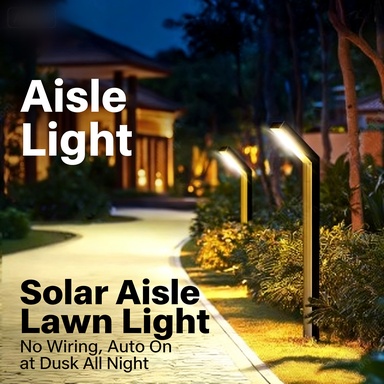
Many people want to install lights under the eaves of their front door or garage entrance to illuminate the way in, but don’t want the hassle of running electrical wires. This leads to the question: can solar LED lights, which don’t require wiring, be installed under the eaves? The answer is: of course! But there’s a crucial prerequisite—the solar panel must receive sunlight. Today, we’ll explain the ins and outs of installing solar LED lights under the eaves, making it easy even for beginners.Can Solar LED Lights Be Installed in Hallways?
First, let’s address the core issue: how do you get the solar panel in the sun? The area under the eaves is usually shady, so directly installing the solar panel there won’t work; it will be “starved” and unable to charge. There are two common methods: The first is to install the light fixture under the eaves, fixing the solar panel to the outer wall, roof edge, or nearby fence—anywhere it receives sufficient sunlight. Then, connect the two with a wire; 5-10 meters of wire is perfectly sufficient. The second option is to choose an adjustable-angle solar light. Install the light under the eaves, with the solar panel extending slightly outwards to avoid obstruction by the eaves and facing the sun.What types of solar LED lights are there?
Next, choose the right type of light. For eaves-mounted lights, prioritize these two types. The first is a wall-mounted sensor light, small in size, simply fixed to the wall under the eaves. It turns on when someone approaches and turns off when no one is around, making it very energy-efficient and suitable for front door installations. The second is a small floodlight. If you want to illuminate a larger area, such as the open space in front of a garage, choose this type. The light is concentrated and bright enough, making it convenient for driving into the garage or moving things at night.Which way should the solar LED light charging panel face?
Waterproof performance is crucial! While eaves can block most rain, rainwater can still splash onto the light during strong winds and heavy rain. Therefore, you must choose solar LED lights labeled “IP65 or higher waterproof rating.” These lights are resistant to heavy rain and dust, making them perfectly fine for outdoor installation. Many people overlook this point and buy non-waterproof lights, which short-circuit and fail after a short time, wasting money.
Installation should be simple and convenient, without needing a professional installer. Many overseas families prefer to install them themselves, choosing models that require no drilling or only simple drilling. No-drill lights can be fixed with strong 3M adhesive and are suitable for installation on smooth walls such as tiles and metal; those requiring drilling are fixed with expansion screws for a more secure fit, suitable for wooden or cement walls. When installing, be careful not to install the light too low, otherwise it will be easily bumped, and avoid installing it in too-hidden corners, otherwise the sensor will not be sensitive.
Battery capacity is also important. Solar panels under the eaves may have a shorter exposure time than completely open-air panels, so it is recommended to choose lights with a battery capacity of 2000mAh or more. This way, even on cloudy days, it can last for 2-3 days without worrying about it suddenly stopping at night. Additionally, choose lights with light sensors; they will not turn on during the day regardless of whether anyone is passing by, only triggering the human body sensor at night, further saving energy.
A common example: In many suburban homes in Europe and America, solar sensor lights are installed under the eaves of the garage entrance. They fixed the light fixture under the eaves and installed the solar panel on the edge of the garage roof, facing due south (in the Northern Hemisphere) to ensure ample sunlight. When driving back at night, the light automatically turns on as the car approaches the garage, illuminating the way in without having to fumble for the switch in the dark – incredibly convenient.
If your eaves are particularly wide and completely block sunlight, there’s a solution. You can choose a model with detachable solar panels. During the day, you can take the solar panels to the yard, balcony, or other sunny spots to charge, and then reinstall them on the light fixture under the eaves at night. This method is slightly more troublesome, but it’s a good option for completely sun-blocking eaves. It’s also suitable for renters, as you can take it with you when you move.