
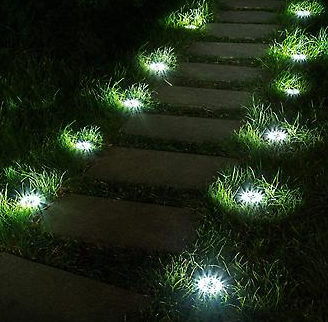
When creating a beautiful night view of your garden, choosing the right solar garden lights is often a major challenge – the question of “ground-mounted or wall-mounted?” is particularly frequently asked. Both offer advantages like energy efficiency and no wiring required, but their applicable scenarios, decorative effects, and user experience differ significantly: ground-mounted lights are convenient to install and suitable for ground accents; wall-mounted lights are flexible and versatile, excelling at creating ambiance. Choosing the right light can make your garden’s night view much more effective, while choosing the wrong one can result in lights that are “unusable and unattractive.” This article will analyze these differences in detail, covering core distinctions, suitable scenarios, and key selection factors, helping you make the optimal choice based on your garden’s needs.Solar LED Light Color Temperature Selection
I. First, Clarify the Core Differences: Ground-mounted vs. Wall-mounted Solar Garden Lights
To determine which is better, we must first understand their core characteristics and differences. We’ve provided a clear comparison across four dimensions: installation method, core advantages, applicable scenarios, and limitations, to help you quickly understand:Solar Streetlight Battery Capacity
- Ground-mounted Solar Garden Lights: The “Flexible Decorator” of the Ground
- Installation Method: Comes with a ground-mounted base; simply insert it directly into the soil beside lawns, flower beds, or walkways—no additional fixing parts required.
- Core Advantages: Zero installation difficulty; no drilling or wiring required, even women can easily operate it; the position can be adjusted at any time, flexibly adapting to different scenarios; low center of gravity, strong wind resistance, and more stable for outdoor use.
- Applicable Scenarios: Garden walkway guidance, lawn embellishment, flower bed edging, and lighting around low-lying plants.
- Limitations: Dependent on soil conditions; cannot be used on paved surfaces (such as stone paths or terraces); relatively low lighting height, mostly suitable for localized, short-distance lighting.Lightning Protection Design for Solar Street Lighting Systems
- Hanging Solar Garden Lights: Aerial Atmosphere Makers
- Installation Method: Requires hooks, cable ties, or other fasteners to hang from branches, pergolas, trellises, walls, eaves, or other high locations; some models support magnetic or nail mounting on smooth/wooden surfaces.
- Core Advantages: Wider lighting range and larger light coverage area; stronger decorative effect, creating immersive effects such as “starry sky ceilings” and “light and shadow corridors”; not limited by ground conditions, usable on hardened ground and in areas without soil.
- Applicable Scenarios: Pergolas/trellis decoration, wall boundary demarcation, eaves embellishment, tree entwining decoration;
- Limitations: Installation requires finding a secure hanging point, relatively cumbersome; wind resistance is affected by hanging stability, requiring proper securing; some models integrate the solar panel with the light body, requiring consideration of hanging location and light conditions.
II. Choosing the Right Light for Your Scenarios: Prioritize Ground-Mounted/Hanging Lights in These Situations
There is no absolutely better type, only more suitable scenarios. To achieve the best results, choose the right lighting based on your garden layout and usage needs:
- Three situations where ground-mounted lights are preferred:
- Scenario 1: Gardens with large lawns and flower beds require guiding lighting along walkways. For example, a walkway from the garden entrance to the house entrance can be illuminated along both sides with ground-mounted string lights or ground lamps. This illuminates the path to prevent bumps and outlines the walkway, creating a beautiful ambiance.
- Scenario 2: Limited budget, limited DIY skills, and a preference for easy installation. Ground-mounted lights require no special tools; simply unpack and insert them into the soil. Adjusting their position later is also convenient, making them suitable for beginners or users who don’t want the hassle.
- Scenario 3: Need for close-range, localized lighting/decorative effects. For example, lighting key flowers in flower beds or embellishing the perimeter of relaxation areas on the lawn. Ground-mounted lights, at a moderate height (30-50cm), provide soft, non-glaring light that precisely highlights decorative elements.
- For purchases, please add the following WhatsApp contact.

- Three Situations Where Hanging Lights Are Preferred:
- Scenario 1: Gardens primarily with paved surfaces (such as stone paths or terraces) or lacking large areas of soil. For example, terrace gardens and rooftop gardens where ground stakes cannot be inserted; hanging lights can be perfectly fitted by attaching to railings, awnings, or wall hooks.
- Scenario 2: Need to create a large-scale decorative atmosphere. For example, in a relaxation area under a pergola, hanging net lights or long strings of copper wire lights can create a “starry sky ceiling”; hanging meteor lights on both sides of a pergola can form a “light and shadow corridor,” suitable for family gatherings and holiday decorations.
- Scenario 3: Need to define building or garden boundaries. For example, garden walls, gate outlines, and house eaves; using hanging string lights along the edges can clearly define spatial boundaries and enhance the overall sophistication of the garden; in gardens with many trees, hanging copper wire lights can be wrapped around branches, creating a fairytale-like atmosphere when illuminated at night.
- Best Combination Solution: Ground-mounted + Hanging String Lights
Most gardens are not single-scene applications; therefore, a combination of both is recommended to balance practicality and aesthetics. For example, use ground-mounted string lights to guide the way along walkways, use hanging string lights to create a “starry sky” effect on pergolas, use ground-mounted lights to adorn the lawn, and use hanging lights to outline the walls, creating a layered and visually appealing garden nightscape.
III. Essential Considerations for Selection: Besides Type, These 3 Factors Cannot Be Ignored
After determining the type, pay attention to the following details to avoid the problem of “choosing the right type but it not working”:
- Solar Panel Lighting Conditions
- Ground-mounted: Some models have the solar panel integrated with the light body. During installation, ensure the top of the light body is unobstructed and can receive sufficient sunlight. If installed under trees, it is recommended to choose a ground-mounted light with a separate solar panel, extending the panel to the light source.
- Wall-mounted: For integrated models, choose those where the hanging position receives sunlight or have an extendable solar panel. For separate models, the solar panel can be fixed to a sunny wall or the top of a flower stand, allowing the light body to be freely hung for decoration.
- Waterproof Rating and Outdoor Compatibility
Garden lights are exposed to the outdoors for extended periods and need to withstand wind, rain, and dew. Prioritize products with an IP65 or higher waterproof rating. For ground-mounted lights, pay attention to the sealing of the ground socket to prevent soil moisture intrusion. For wall-mounted lights, check the waterproof performance of the wiring and interfaces to prevent short circuits caused by rain.
- Battery Life and Brightness Requirements
Choose based on usage time: For nighttime leisure use (3-4 hours), a standard battery life is sufficient; for all-night lighting (8 hours or more), choose a model with a large-capacity battery. Regarding brightness, choose 30-50lm soft light for walkway lighting, 10-30lm low light for ambient lighting, and 50lm or more high brightness for accent lighting.
IV. Clarifying Common Selection Misconceptions: Avoid These Mistakes
Misconception 1: Ground-mounted lights can only be used on lawns? — Incorrect. Ground-mounted lights can also be used in flower beds and around the edges of flower pots (simply insert into the soil); they can be used wherever there is soil.
Misconception 2: Hanging lights are complicated to install, too difficult for beginners? — Not necessarily. Choose hanging models with built-in hooks or no-drill options, such as suction cup hooks or cable ties, which are easy to install and even beginners can easily operate.
Misconception 3: Higher brightness is always better? — Incorrect. Garden lighting prioritizes ambiance; overly bright lights can ruin the nighttime atmosphere and may disturb neighbors. Choose brightness according to your needs.
Myth 4: Can’t both be used simultaneously? — Incorrect. Combining them creates a more layered garden nighttime scene, balancing practicality and aesthetics, making it the optimal choice for most families.
Summary: Ground-mounted vs. wall-mounted – the key is “scenario + needs”
Returning to the initial question: Are ground-mounted or wall-mounted solar garden lights better? The answer is: It depends on your garden scenario and usage needs. If you have soil, need walkway guidance, or require easy installation, choose ground-mounted lights; if you need ambiance, paved ground, or high-altitude placement, choose wall-mounted lights; for a comprehensive and high-quality nighttime scene, a combination of both is the best solution.
In fact, the core of selection isn’t “either/or,” but “suitability.” By considering your garden’s layout, soil conditions, decorative needs, and paying attention to details like solar panel light reception, waterproofing, and battery life, you can choose the right solar garden light. If your garden has a unique layout (such as irregular walkways or soilless terraces), or if you need specific selection advice, please leave a message explaining your garden size and usage needs, and we will provide you with a customized solution.