
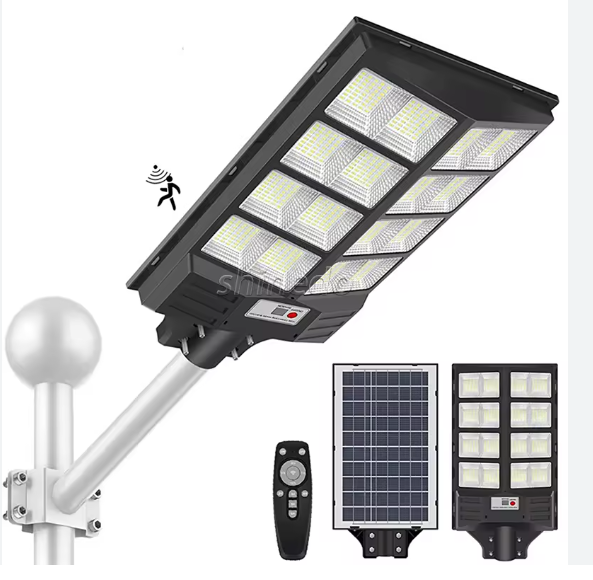
The charging time of a solar LED light depends on several variables. Understanding these variables can help you optimize its performance.
一、核心影响因素
- Sunlight Conditions
- Ideal Conditions: Under direct sunlight, standard products can be fully charged in 2-4 hours.
- Cloudy Weather: Charging time extends to 6-8 hours.
- 雨天:可能需要间歇充电 2-3 天.Solar Street Light Repair Methods
- Seasonal Differences
- Summer (June-August in the Northern Hemisphere): Charging efficiency is highest between 10:00 AM and 2:00 PM.
- Winter (December-February): Effective charging time is reduced by 30%-50%.
- Spring and Autumn: Stable charging can be achieved throughout the day.
- 技术参数
- Solar Panel Power: Each 10W of power reduces charging time by approximately 1 hour.
- Battery Capacity: Common specifications and charging time comparison:
- 1200mAh Battery: Fully charged in 2-3 hours on sunny days.
- 2000mAh Battery: Fully charged in 3-5 hours on sunny days.
- 4000mAh Battery: Fully charged in 6-8 hours on sunny days.
二、充电效率优化方案
Reasons Why Solar Garden Lights Don’t Work at Night
- Optimal Angle: Solar panel tilt angle = local latitude + 15°
- Avoid Shading: No shaded areas throughout the day
- Orientation Adjustment: Due south in the Northern Hemisphere, due north in the Southern Hemisphere
Daily Maintenance Points
- Weekly Cleaning: Wipe the surface of the solar panel with a soft cloth
- Quarterly Inspection: Confirm that the installation angle is not off-center
- Annual Inspection: Measure whether the actual charging current meets the standard
III. Charging Status Identification
Indicator Light System
· Flashing Red: Charging (Power < 30%)
· Solid Red: Charging (Power 30%-80%)
· Flashing Green: Nearly Fully Charged (80%-95%)
· Solid Green: Fully Charged (95%-100%)
Performance Testing Method
- Start timing after the power is depleted
- Record the time to reach full charge
- 与产品的标称充电时间进行比较
四、特殊情况处理
应对连续雨天的策略Do Solar LED Lights Consume Electricity?
- Reduce Usage Frequency: Use every other day or reduce the time the lights are on
- Temporary Charging: Move detachable models to an indoor window location.
- 备用方案:准备一个带USB充电口的应急电源。
Winter Charging Optimization
- Angle Adjustment: Increase the tilt angle by 15°-20° to capture low-angle sunlight.
- Snow Protection: Install a tilting bracket.
- Insulation: Add an insulation layer to the battery compartment (maintain above 0℃).
V. Troubleshooting Abnormal Charging Time
Slow Charging Diagnosis
- Check for obstructions: Leaves, dust, snow.
- Test voltage output: Should be 20% higher than the battery voltage at noon.
- Check battery health: Consider replacement if used for more than 2 years.
无法充满电
For purchases, please add the following WhatsApp contact.
- Measure battery voltage in the afternoon: Should be close to the nominal voltage.
- Check the controller: Check for charging protection.
- Check the connection cable: Check for oxidation and loose connections.
VI. Practical Charging Suggestions
Daily Usage Arrangement
- Morning Placement: Place in the charging location before 8:00 AM.
- Evening Collection: Collect 30 minutes before sunset.
- Weekend Deep Charging: 8 Hours of Continuous Charging to Restore Battery Activity
Long-Term Maintenance Plan
- Monthly: One complete charge-discharge cycle
- Quarterly: Clean the charging port
- Yearly: Check for battery capacity degradation
VII. Technical Parameter Reference Table
Battery Capacity Fully Charged on Sunny Day Fully Charged on Partly Cloudy Day Demand on Overcast Day
1200mAh 2-3 hours 4-6 hours 2-3 days
2000mAh 3-5 hours 6-10 hours 3-4 days
4000mAh 6-8 hours 10-15 hours 5-7 days
Precautions
- Always fully charge for 24 hours before first use.
- Avoid charging in environments above 45℃.
- Suspend outdoor charging during thunderstorms.
- Recharge every 3 months if not used for extended periods.
Through scientific management and regular maintenance, the charging efficiency of solar LED lights can be maintained at its optimal level. Generally, 4-6 hours of effective sunlight per day is sufficient for daily use. In case of special weather conditions, refer to the plan in this document to adjust the usage strategy.