
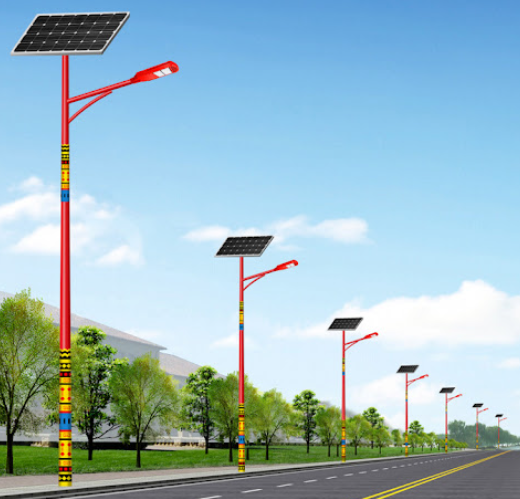
In today’s world, where green and low-carbon concepts are deeply ingrained, solar streetlights, with their advantages of zero energy consumption and zero emissions, have become the mainstream lighting choice for urban roads, rural streets, scenic areas, and parks. Within the entire solar streetlight system, battery capacity, as the core indicator of energy storage and release, directly determines the streetlight’s lighting stability, endurance, and lifespan, making it a key dimension for evaluating the quality of a solar streetlight.Are Solar LED Lights Really Suitable for Your Balcony?
The core working principle of solar streetlights is a “light-electricity-storage-discharge” cycle, with the battery serving as an indispensable “energy warehouse” in this cycle. During the day, photovoltaic panels convert solar energy into electrical energy and store it in the battery; at night, the battery powers the LED light source for illumination. The size of the battery directly determines the energy storage capacity of this “warehouse”—if the capacity is too small, during consecutive cloudy or rainy days, the stored energy may not be enough to power the streetlight, potentially causing it to go out mid-day and affecting nighttime traffic safety; if the capacity is too large, it will increase battery size and cost, and may also lead to decreased battery activity and shortened lifespan due to prolonged periods of incomplete charging. Therefore, appropriately matching battery capacity is a core challenge and key aspect of solar street light system design.Solar LED Light Charging Time
The factors influencing the selection of solar street light battery capacity are diverse and complex, requiring comprehensive consideration of the actual application scenario. Firstly, there are the factors of sunlight conditions. The annual sunshine hours and light intensity vary significantly across different regions. Sunny southern regions and sunnier northern high-latitude regions have drastically different battery capacity requirements. Secondly, there are lighting needs. The duration of streetlight illumination (e.g., 10 hours/night or 12 hours/night) and the power of the light source (30W, 50W, etc.) directly determine the daily power consumption, thus affecting battery capacity selection. Furthermore, the need for backup power during consecutive cloudy or rainy days is also important. Most regions need to guarantee normal lighting for 3-7 consecutive days of cloudy or rainy weather, requiring batteries with sufficient capacity redundancy. Simultaneously, battery type also affects capacity performance. Currently, commonly used lithium batteries and lead-acid batteries differ in energy density and cycle life, resulting in different actual runtime capabilities for the same capacity.Solar LED Light Color Temperature Selection
Scientifically selecting battery capacity not only ensures lighting performance but also improves system economy and stability. In practical design, accurate calculation of daily power consumption and consideration of local meteorological data are needed to determine the number of reserve days, thus arriving at a reasonable battery capacity. For example, a 50W LED solar street light consuming approximately 0.5kWh per day for 10 hours of illumination would require a battery capacity of 2.75-3kWh to guarantee lighting for 5 consecutive days of cloudy or rainy weather, with a 10%-20% capacity redundancy. Simultaneously, a high-quality charge/discharge controller is necessary to prevent overcharging and over-discharging, extending battery life.
For purchases, please add the following WhatsApp contact.
With the continuous development of photovoltaic and energy storage technologies, the matching of solar street light battery capacity is moving towards greater precision and efficiency. The application of new high-energy-density lithium batteries makes small-volume, large-capacity batteries possible, reducing installation difficulty and improving endurance. The widespread adoption of intelligent control systems allows for real-time monitoring of light intensity, power consumption, and other data to dynamically adjust charging and discharging strategies, further optimizing battery capacity utilization.
In conclusion, a larger solar street light battery capacity is not necessarily better; rather, it must be precisely matched to the application scenario, lighting requirements, and meteorological conditions. Choosing the right battery capacity is crucial for solar streetlights to deliver long-lasting illumination and is also an important foundation for promoting the widespread application of solar lighting technology in urban and rural construction. Under the general trend of green development, accurately controlling battery capacity—this core indicator—is essential for solar streetlights to better serve the people and contribute to the construction of a low-carbon society.