
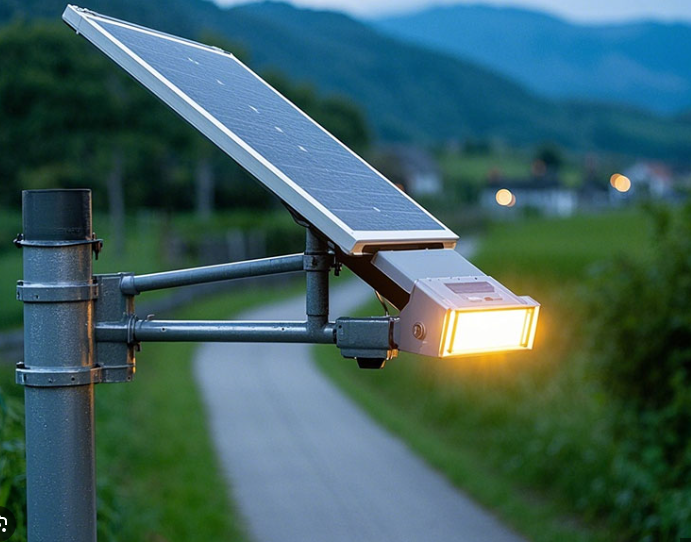
On the network of urban and rural roads, solar streetlights are becoming dazzling stars adorning the night. However, when these individual light-emitting bodies are connected in a line, a crucial question arises: how far apart should they be? This seemingly simple question of “spacing” is actually a precise science, determining the safety, economic efficiency, and lifespan of the system.
The Importance of Spacing: Beyond Simple Arrangement
The installation distance—the length of the “dark zone” between adjacent light poles—is the core of lighting design. It is not a simple division, but a difficult balance of multiple objectives. The primary objective is safety; uniform light eliminates dangerous boundaries between light and shadow, avoiding visual fatigue caused by frequent pupil dilation and contraction in drivers. Secondly, there is economic consideration; covering the longest path with the fewest nodes while meeting lighting standards is a responsible investment in public resources. Most uniquely, the spacing of solar streetlights also affects their own “survival”; overly close arrangement may cause the photovoltaic panels to shade each other, depriving them of the sunlight they depend on for survival. The Four-Dimensional Symphony of Distance
Finding the optimal distance is like solving a four-variable equation, where every variable has a ripple effect.Are Solar LED Lights Really Suitable for Your Balcony?
First Dimension: Pole Height and Light Intensity. This is the most intuitive physical basis. Generally, the taller the pole, the wider the halo coverage. A widely adopted rule of thumb is that the installation distance should be controlled between 3 and 3.5 times the pole height. For example, a 6-meter-high streetlight should have its companion positioned approximately 18 to 21 meters away. However, with increased height, to illuminate a wider area, the light source power and battery capacity must also be increased accordingly, creating a dynamic balance between cost and efficiency.Solar LED Light Charging Time: Key Factors and Optimization Strategies
Second Dimension: How Light is Shaped—The Art of Lens Light Distribution. Light is not always evenly distributed; it is carefully sculpted by the lens of the lamp head. Rectangular light distribution confines the light into a rectangular spot that conforms to the road’s direction, concentrating energy, increasing efficiency, and allowing the streetlight to be positioned further apart. Traditional circular light distribution, like splashing water in all directions, is wasteful, but it has its uses at specific intersections. The choice of “light pattern” directly sets the initial parameters for spacing.Which Material Is Best for Solar Garden Lights?
The third dimension: Road scale and grade. A quiet country lane and a busy town main road have vastly different light requirements. National standards specify clear illuminance and uniformity indicators for lanes and sidewalks of different widths and functions. Typically, in the common double-sided symmetrical lighting pattern, the ideal installation distance is about 5 to 7 times the width of the road itself. The physical scale of the road itself is the canvas that defines all calculations.
For purchases, please add the following WhatsApp contact.
The fourth dimension: The sun’s trajectory and the sky’s brightness—the unique constraints of solar energy. This is the key constraint that completely distinguishes solar streetlights from traditional streetlights. The spacing must be set to ensure that on the winter solstice, when the daylight hours are shortest, the solar panels on adjacent light poles do not cast shadows during critical charging periods (such as 9 am to 3 pm), thus depriving each other of energy. In areas with persistent rain, larger batteries are needed to ensure extended battery life. This often necessitates smaller spacing between lights to reduce individual lamp power consumption and control overall cost.
From Principle to Path: Distance Solving in Practice
How should practitioners approach complex variables? A simplified logical chain is an effective tool.
First, clarify the basic attributes of the road: its width and functional positioning. A 6-meter-wide community road and a 10-meter-wide county road have different starting points.
Second, choose the lighting layout. Single-sided lighting is suitable for narrower roads, staggered lighting provides better uniformity, while symmetrical double-sided lighting is the standard for mainstream wide roads, providing the most balanced lighting environment.
Next, use empirical formulas for estimation. For roads using efficient rectangular light distribution and double-sided lighting, a reliable starting point is to ensure the installation distance is no more than 3.5 times the pole height. Then, verify this using a relationship of 5 to 7 times the road width, taking the more conservative (usually shorter) value as the initial solution.
Finally, and indispensable in solar street light design, is shading analysis. The design drawings must simulate the sun’s trajectory at a low angle during winter, rigorously testing whether each photovoltaic panel can escape the shadows of its neighbors and embrace full sunlight. This step determines whether the design on paper can shine brightly in reality.
A Wise Balance: Suggestions and Warnings
In specific scenarios, we can sketch a general picture. For rural roads and pedestrian paths, a pole height of 4 to 5 meters, combined with a spacing of 12 to 18 meters, using a single-sided or staggered layout, often balances cost and effectiveness. For two-lane roads in the heart of towns, a pole height of 6 to 7 meters and a spacing of 18 to 25 meters, creating a symmetrical light corridor on both sides, is a more typical choice.
However, true wisdom lies in dynamic adjustment. A long road may traverse open fields and dense forests; stubbornly using a uniform spacing is mechanical. Appropriately increasing the spacing in areas with obstructed sunlight and reasonably extending it in open areas is the art of adapting to local conditions.
We must be wary of common pitfalls: We cannot excessively widen the spacing simply to save on initial investment, leading to a dangerous “zebra effect” in lighting; we cannot focus solely on the procurement of light poles and bulbs while neglecting the light distribution design that determines luminous efficacy; and we cannot plan solely based on summer sunlight, leaving the entire system exhausted during the long winter.
Conclusion: Measuring the Civilization Between Light and Shadow
The installation distance of solar streetlights ultimately measures our wisdom and sincerity in seeking a balance between safety, economy, and sustainability. There is no one-size-fits-all answer, but there is a rigorous path that respects optical principles, engineering data, and natural laws.
As technology advances, future intelligent streetlights may be able to dynamically adjust the brightness of each lamp by sensing traffic flow and skylight, thus achieving deeper energy savings with more elegant spacing. But no matter how technology evolves, the initial planning that illuminates the road, and the precise calculation of light and shadow, will always be the cornerstone of our civilization—laying safety and conveying warmth in the darkness. Every journey illuminated by science begins with a profound understanding of the complex world behind the simple number “distance”.