
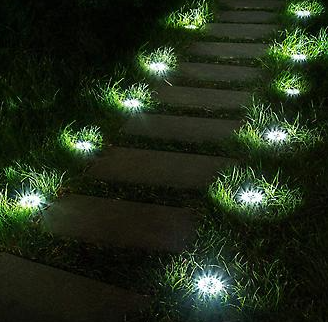
Solar garden lights, with their energy-saving, environmentally friendly, and diverse designs, have become a popular choice for courtyard decoration and path lighting. Many consumers are confused when choosing: which solar garden light is brightest? In fact, the brightness of a garden light is not determined by a single factor, but is closely related to several core elements such as the type of light source, power, battery capacity, and optical design. This article will break down these key factors one by one to help you accurately determine “which solar garden light is brighter” and easily select a product that suits your needs.Analyzing the Illumination Range of Solar Streetlights
The type of light source is the core foundation for determining brightness. Currently, mainstream solar garden lights mainly use LED light sources, and different types of LED light sources have significantly different brightness performances. Among them, COB LED light sources, due to their high chip integration and concentrated light-emitting area, generally have better brightness than traditional SMD LED light sources. At the same power, COB LEDs have higher luminous flux, more uniform light, and no obvious dark areas, making them suitable for garden areas requiring focused lighting; while SMD LED light sources offer more flexible designs and are suitable for scenarios where decoration outweighs lighting needs. Furthermore, some inferior products use ordinary incandescent or fluorescent lamps, which not only have low brightness but also suffer from high energy consumption and short lifespan; these are not recommended.Solar LED Light Color Temperature Selection
Power directly relates to the upper limit of brightness, making it the most intuitive reference indicator when purchasing. Generally, solar garden lights have a power range of 5W-30W; the higher the power, the stronger the brightness. 5W-10W products have weaker brightness and are suitable for creating a warm atmosphere, such as garden paths and around flower beds; 15W-20W products have moderate brightness and can meet the needs of daily activities in the yard, such as terraces and leisure areas; 25W-30W products have strong brightness and are suitable for larger gardens or areas requiring high-brightness lighting, such as around swimming pools and parking lot entrances. It is important to note that higher power is not always better; the choice should be based on actual lighting needs to avoid energy waste.Which Material Is Best for Solar Garden Lights?
Battery capacity and charging efficiency are key to ensuring stable brightness. Solar garden lights rely on batteries to store electrical energy. If the battery capacity is insufficient, even with a high light source power, problems such as rapid brightness decay and short lighting time may occur. High-quality products typically use lithium batteries with capacities between 1000mAh and 5000mAh, offering long battery life and high charging efficiency. In contrast, inferior lead-acid batteries not only have small capacity but also suffer from short charge-discharge cycle life and poor low-temperature performance, leading to a significant decrease in brightness on cloudy days or in winter. Furthermore, the conversion efficiency of the solar panel also affects charging performance. High-efficiency monocrystalline silicon solar panels charge faster than polycrystalline or amorphous silicon panels, better ensuring battery energy storage and stable light brightness.
For purchases, please add the following WhatsApp contact.
Optical design plays a crucial role in maximizing brightness. A well-designed lens and reflector structure concentrate light, increasing ground illumination and making the “brightness” more pronounced. Conversely, a poor optical design can cause light dispersion, resulting in a seemingly bright light source but poor actual ground lighting. Additionally, the installation height and angle of the light fixture also affect perceived brightness. A height of 2.5-3.5 meters and an angle of 5°-10° are generally recommended to allow for better light coverage of the target area.
In summary, to choose a bright solar garden light, prioritize products with COB LED light sources, power ratings that match your needs, sufficient lithium battery capacity, and a reasonable optical design. If ambient lighting is the primary focus, choose COB LED products under 10W; for everyday activity lighting, 15W-20W lithium battery products are more suitable; and for large-area high-brightness applications, choose high-quality products over 25W. By considering your garden size and lighting needs, and taking all these factors into account, you can select a solar garden light that combines brightness and practicality, ensuring a safe and beautiful garden at night.